Catherine the Great: The Rise, Expansion and Enlightenment Achievements of a Generation of Russian Empresses
As the longest-reigning empress in the history of the Russian Empire, Catherine the Great not only seized power through coups, but also brought Russia into the so-called "golden age" with her outstanding political skills, admiration for Enlightenment ideas, and large-scale territorial expansion. By understanding the ruling style of this legendary woman, you can also conduct an in-depth 8values political value orientation test to compare the characteristics of different ideologies under the collision of monarchy and the Enlightenment.
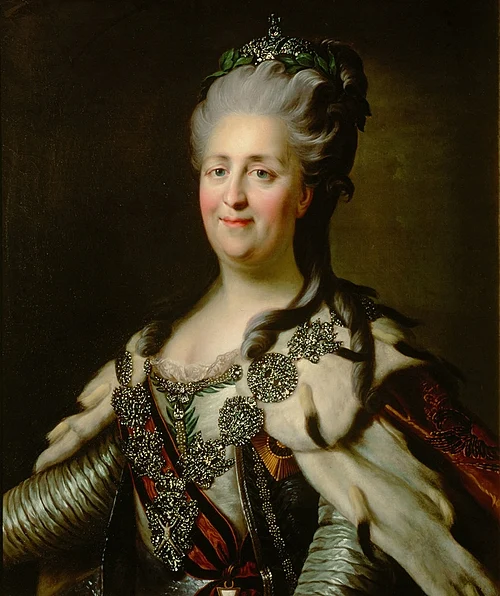
Catherine II (Russian: Екатерина II Алексеевна, May 2, 1729 - November 17, 1796), historically known as Catherine the Great , was the Empress of the Russian Empire . She was originally a princess of the German principality of Anhalt-Zerbst and entered the Russian court through a political marriage with Peter III. In 1762, she launched a palace coup to depose her husband and officially ascended the throne. During her reign, she promoted Enlightened Absolutism internally and reformed the administrative system; externally, she established Russia's status as a European power by annexing Poland, Crimea and the Ottoman Empire through multiple wars.
Catherine was born in Stettin, Prussia in 1729. In 1796, the great monarch known as the "Mother of All Russia" died in Tsarskoye Selo, St. Petersburg, leaving behind a huge empire with unprecedented scope.
_Want to know which historical leader your decision-making style is most similar to? Try the Political Leader Decision-Making Style Test to see if you have the courage and strategy of Catherine the Great. _
The German Princess's Road to Russia and Awakening to Power
Catherine's original name was Sophie Auguste Friederike . She was not from a top royal family. Her father was only a major general in the Prussian army with a small territory. However, her fate took a turn when she was 14 years old. Thanks to the help of Prussian King Frederick the Great, she was selected by Russian Empress Elizabeth as the marriage partner of Crown Prince Peter III.
After entering Russia in 1744, young Sophia showed extremely high political talent and adaptability. She knew very well that in order to take root in a foreign country, she had to win the support of the people and the church. To this end, she studied Russian crazily, studied Orthodox teachings, converted to Orthodox Christianity in 1745, and changed her name to Ekaterina Alexeevna . In contrast, although her husband Peter III was of Russian royal descent, he worshiped Prussia extremely and blatantly despised Russian culture and religion. This paved the way for future power transitions.
During her 18-year career as a concubine, Catherine read extensively the works of Enlightenment thinkers such as Voltaire and Montesquieu, and maintained correspondence with European literati. She once said to herself: "Although I am alone, I never feel lonely. Books are my best teachers." This period of living in seclusion not only tempered her will, but also enriched her political theory reserve.
The Coup 1762: From German Orphan to Russian Empress
In early 1762, Queen Elizabeth died and was succeeded by Peter III. His series of actions after coming to power were extremely unpopular: he not only immediately stopped the war against Prussia (even though Russia was about to win), he also forced the Russian army to change into Prussian uniforms, and planned to confiscate the Orthodox Church's real estate.
Catherine realized that if she allowed Peter III to rule, she would be in danger of being deposed or even imprisoned. She began to secretly win over the Guards officers, especially the Orlov brothers . On July 9, 1762, Catherine proclaimed her accession to the throne surrounded by the Guards in St. Petersburg. Peter III signed the edict of abdication in the face of betrayal and separation, and died suddenly under house arrest shortly after.
Although Catherine's accession to the throne lacked legitimacy at the legal level, she quickly gained the allegiance of the nobility and the military by virtue of her firm defense of Russian interests. She is well versed in political propaganda and claims to the outside world that she is trying to save the Orthodox Church and the Russian state from being destroyed by a "mad monarch".
Enlightened Despotism: Internal Reform under Enlightenment Thoughts
Catherine the Great was a typical enlightened autocratic monarch of the 18th century. She tried to apply the rationality and order of the Enlightenment to vast Russia, but this in no way meant giving up imperial power.
In 1767, she convened a legislative council composed of all classes (except serfs) and personally drafted a legal program called the Nakaz. This platform quoted extensively from Montesquieu's "The Spirit of the Laws", advocating equality before the law and opposing torture. Although the commission was eventually disbanded due to conflicts of interest and the outbreak of war, it represented Catherine's vision for reconstructing the rule of law in Russia.
Administratively, she divided Russia into 50 provinces and consolidated centralization by strengthening local management. She also established the privileged status of the nobility through the "Charter of Nobles", which strengthened the foundation of rule, but also led to the further solidification of the serfdom system . The Pugachev's Rebellion that broke out in 1773 was the largest peasant uprising in Russian history. Catherine adopted extremely brutal military suppression. After that, her attitude toward reforms at the bottom of society became conservative.
In the fields of education and health, Catherine achieved excellence. She founded the famous Smolny Palace , the first state-funded school for girls in Europe. During the smallpox epidemic, she took the lead in vaccinating against smallpox and established the first modern hospital system in Russia.
When analyzing Catherine's ruling model that combines "free thought" and "iron-fisted centralization", it helps us to reflect on the boundaries of power and rights. You can measure your inclination on such issues by taking the 8values political values orientation test , and view detailed interpretations of all 8values ideological results .
Territorial Expansion: Access to the Black Sea and the Partition of Poland
If Peter the Great opened the "window" to the Baltic Sea for Russia, then Catherine the Great opened the "door" to the Black Sea for Russia. Her diplomatic goals were extremely ambitious, the so-called "Greek Plan", which aimed to completely defeat the Ottoman Empire and rebuild the Eastern Roman Empire with Russia as its protector.
Through two Russo-Turkish wars , Russia achieved decisive victories. The 1774 Treaty of Kuchuk-Kenage gave Russia a foothold on the northern shores of the Black Sea. In 1783, Catherine officially annexed the Crimean Peninsula , which not only gave Russia the strategic location of Crimea, but also led to the establishment of the Black Sea Fleet, making Russia one of the true Mediterranean powers.
In the West, Catherine took advantage of the decline of the Polish-Lithuanian Commonwealth and led the three partitions of Poland (1772, 1793, 1795). Through these political games, Poland disappeared from the map as a sovereign country, while Russia expanded hundreds of thousands of square kilometers of territory westward, annexing most of Lithuania, Belarus, and Western Ukraine.
By the end of Catherine's reign, the Russian Empire had expanded by approximately 520,000 square kilometers to the west and south. She once proudly declared: "I came to Russia impoverished, but when I left, I left it a great empire."
Center for cultural renaissance and enlightenment salons
Catherine the Great was not only a warrior and statesman, but also a patron of the arts and sciences. She laid the foundations of the Hermitage Museum (Hermitage Museum) through large-scale acquisitions of art treasures from across Europe.
She maintained lifelong correspondence with philosophers such as Diderot and Voltaire. When Diderot fell into financial crisis, Catherine bought his library and generously hired him as director of her personal library, even giving him a 50-year salary advance. This kind of political investment greatly enhanced Russia's soft power in Europe, and the European intelligentsia at that time generally praised the Russian Empress.
Catherine herself was a prolific writer, writing plays, essays, memoirs, and even a children's encyclopedia. Under her influence, French became the official language of Russian aristocratic society, and the architecture of St. Petersburg also shifted from the traditional onion style to the elegant classicism style.
Reflections on later life and legacy controversies
The outbreak of the French Revolution in 1789 greatly affected Catherine. As Louis XVI was guillotined, her enthusiasm for Enlightenment ideas quickly cooled, and she turned to strict censorship to prevent revolutionary ideas from being introduced into Russia. She even ordered a ban on the burning of Voltaire's works, which showed that as a monarch, she would not hesitate to abandon the ideals she once admired when her power was threatened.
History is filled with extremely exaggerated and even malicious rumors about Catherine's private life. In fact, Catherine did have many lovers in her life, including the famous military general Grigory Potemkin. However, her choice of lovers was often based on political or military talent, and Potemkin played an irreplaceable role in the annexation of Crimea and the construction of Novorossiya.
Catherine the Great died of a stroke in St. Petersburg on November 17, 1796 at the age of 67. Her son Paul I succeeded to the throne. Although Paul tried to abolish many of his mother's policies, the powerful empire left by Catherine was already unshakable.
Catherine the Great’s Historical Evaluation and Later Influence
Catherine the Great's 34-year reign was a peak in Russian history. Her influence on human history can be observed from the following dimensions:
1. Territorial and military supremacy
Through diplomacy and war, she completely changed the political landscape of Eastern Europe. Russia transformed from a peaceful landlocked country into a superpower spanning Europe and Asia, and was deeply involved in European affairs.
2. The two-sided nature of the system
Although Catherine advocated freedom in words, in fact she strengthened serfdom . During her reign, serfs were almost the same as slaves, which intensified the class contradictions in Russian society and laid the foundation for social unrest in the 19th century and revolutions in the 20th century.
3. The leap between culture and science
The Western civilization she introduced gave Russia a generation of intellectuals with a global perspective. Under her leadership, St. Petersburg has truly become a European cultural center as famous as Paris and London.
4. A model of female empowerment
In that era of absolute male dominance, Catherine not only held the highest power, but also successfully maintained the stability of her rule. Her political life relied not only on force, but also on her extremely high emotional intelligence and ability to balance the interests of the nobility.
As historians say, without Catherine II, the modernization of the Russian Empire would have been delayed by decades. She is a complex character: she is both generous and cruel, both progressive and authoritarian, both a rational philosopher and an emotional lover.
Extended reading : If you want to explore your own political decision-making tendencies, you are welcome to go to the Political Test Center and experience the Political Leaders Decision-making Style Test . Through 48 professional questions, you will analyze your leadership characteristics from six dimensions such as decision-making style, power concept, and economic philosophy to see whether you are most like Catherine the Great, Peter the Great, or other historical leaders.