Otto von Bismarck: Founder and Iron Chancellor of the German Empire
Otto von Bismarck, one of the greatest politicians of the 19th century, unified Germany through the "iron and blood policy" and established a complex European balance of power system. His Realpolitik thinking not only changed the European map, but also laid the foundation for the modern welfare state. By understanding this Machiavellian master, you can also conduct an in-depth 8values political values test to compare the characteristics of different ideologies.
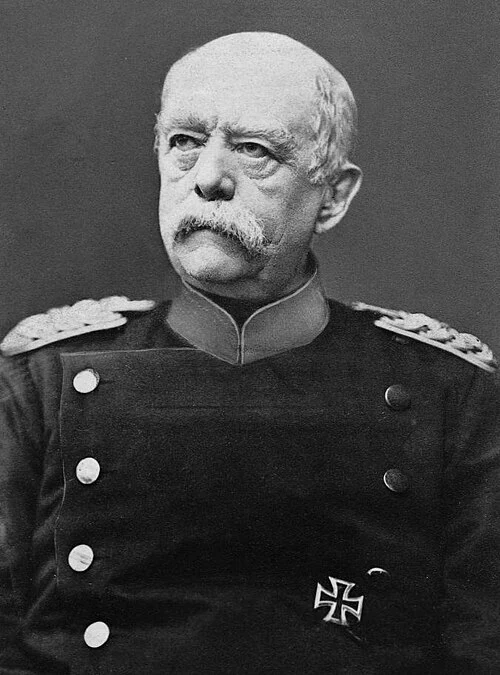
Otto von Bismarck (German: Otto von Bismarck, April 1, 1815 - July 30, 1898) was the first Imperial Chancellor of the German Empire, known as the "Iron Chancellor" (Länderübergreifend). Through a series of diplomatic means and three dynastic wars, he ended Germany's long-term state of division and separatism and promoted the unification of Germany . As a representative figure of conservatism and realist politics , he not only attacked the socialist movement in domestic policy, but also pioneered the establishment of a social security system ; in foreign policy, he cleverly used the contradictions between major powers to build the "Bismarck System" that has maintained peace in Europe for more than 20 years.
Bismarck was born on April 1, 1815 in Schönhausen, Saxony, Prussia. He died on July 30, 1898 at his estate in Friedrichsrue. His life was the epitome of the rise of Prussia and the pinnacle of the art of balancing power in Europe.
_Want to know which historical leader your decision-making style is most similar to? Try the Political Leader Decision-Making Style Test to see if you have Bismarckian traits of calmness and Machiavellianism. _
Juncker's Landlord Origin and Early Rebellion
Bismarck was born into a typical Junker landowner family. His father was a traditional Prussian aristocrat, and his mother came from a family of highly educated civil servants. This background gave him an aristocratic conservative background and a keen insight into the bureaucracy. However, Bismarck was not a model student in his youth. While studying law at the University of Göttingen and the University of Berlin, he was known for his drunkenness, duels and extravagant spending, and was known as "The Furious Bismarck."
After a brief career as a civil servant, he returned to his homeland to run the business. This farming experience gave him a deep understanding of the interests of the landed aristocracy. In 1847, Bismarck entered the Prussian Union Parliament and officially entered politics. At this time, he was a staunch extreme royalist . In the European Revolution of 1848, he firmly stood on the side of the royal family and advocated the use of force to suppress the democratic movement. This not only won him the trust of William I, but also established his political tone of solving problems through strength rather than parliamentary debate.
From 1851 to 1862, Bismarck served as Prussian representative to the Bundestag, ambassador to Russia, and ambassador to France. More than ten years of diplomatic baptism allowed him to see through the reality of European powers. He realized that if Prussia wanted to become strong, it must break Austria's hegemony within the German Confederation, and this goal could only be achieved through power politics.
The rise of the "Iron Chancellor" and the war of German unification
In 1862, Prussia was in a serious constitutional crisis. Parliament refused to approve King William I's funding for military expansion, and the king briefly considered abdicating. At this juncture, Bismarck was appointed Prime Minister and Foreign Minister. He made his famous speech before the Parliamentary Budget Committee:
"The great problems of our time will not be solved by speeches and majority decisions... but by Eisen und Blut ( iron and blood )."
This passage became the hallmark of his political career. Bismarck defied parliamentary procedures, bypassed the budget and forcibly expanded the military, and began his magnificent road to unification.
The Art of Three Dynasty Wars
Bismarck's unification strategy was not a simple expansion of force, but a perfect combination of politics and military:
- Prudential War (1864): He teamed up with Austria to defeat Denmark and recaptured Schleswig and Holstein, while laying the trigger for uneven distribution of benefits with Austria.
- Austro-Prussian War (1866): Bismarck used diplomacy to isolate Austria and won the Battle of Sadowa. After the war, he withstood the pressure from the domestic military and insisted on granting Austria a decent peace agreement, without ceding territory or paying indemnities, in order to prevent Austria from becoming a mortal enemy in the future. This foresight paid off in the future.
- Franco-Prussian War (1870): Bismarck used the "Emes Telegraph Incident" to anger Napoleon III and trigger the war. Through this war, he successfully aroused nationalist enthusiasm throughout Germany and urged the southern states to join the Prussian camp.
On January 18, 1871, William I was crowned Emperor of Germany in the Hall of Mirrors at the Palace of Versailles. At this point, a German Empire with Prussia as its core was officially born.
Operator of the European Balance of Power: Bismarck System
The establishment of the German Empire broke the pattern of Europe since 1815. Bismarck knew that a strong Germany would inevitably arouse fear in its neighbors. In order to prevent the emergence of an anti-German alliance, he transformed from a "revolutionary" to a "defender of peace".
He constructed an intricate alliance system , the core logic of which was to ensure that Germany would always be "one of the three parties" in any relationship between the five major powers. The "Three Emperors Alliance" (Germany, Russia, and Austria) established in 1873, the "Triple Alliance" (Germany, Austria, and Italy) in 1882, and the "Reinsurance Treaty" signed with Russia in 1887 constituted his firewall to protect the security of the empire.
The essence of Bismarck's diplomacy was to isolate France and act as an "honest broker" in the conflict between Austria and Russia. His performance at the Berlin Conference of 1878 fully demonstrated how he could maintain the balance of power among the great powers without being directly involved in the conflict. The restraint he showed in international affairs enabled Germany to enjoy a long period of peaceful development in the late 19th century.
Domestic Policy Contradictions: Repression and Welfare Parallel
When analyzing Bismarck's pragmatic political operations, we can see his art of balancing between maintaining authoritarian rule and social stability. You can measure your inclination on such issues by taking the 8values political values orientation test , and view detailed interpretations of all 8values ideological results .
"Sugar Carrot and Stick"
Bismarck implemented authoritarian rule internally and regarded any political force that challenged imperial power as an "enemy of the empire" (Reichsfeinde).
- Cultural Struggle (Kulturkampf): In order to combat the Catholic Center Party, which was loyal to the Holy See, he launched a years-long cultural struggle in an attempt to limit the influence of the church in education and politics, but ultimately compromised with little success.
- Anti-Socialist Law (Sozialistengesetz): Facing the socialist trend brought about by industrialization, Bismarck pushed for the passage of this law in 1878, prohibiting the activities of socialist organizations.
However, Bismarck did not only know repression. He realized that in order to completely eliminate the risk of revolution, the situation of the working class must be improved. Starting in 1883, he successively promulgated the "Sickness Insurance Law" , "Accident Insurance Law" and "Disability and Pension Insurance Law" . This was the world's first modern social insurance system, and Bismarck is regarded as one of the founders of the modern welfare state . The original intention of this "state socialist" initiative was to consolidate conservative rule, not out of democratic ideals.
The Fall of the Imperial Chancellor: Conflict with Wilhelm II
In 1888, the "Year of the Three Emperors" changed the direction of Germany. Wilhelm II ascended the throne at the age of 29. The young emperor was ambitious and dissatisfied with Bismarck's long-term control of government. He also had serious differences with Bismarck on the domestic (treatment of workers' strikes) and external (policy toward Russia) lines.
In March 1890, Wilhelm II forced Bismarck to resign after a dispute over cabinet powers. The "Architect of the Empire" left a prophecy that "he will see the collapse of this empire in 20 years" and returned to his territory lonely. Bismarck did not remain silent after his resignation. He wrote his memoirs "Thoughts and Memories" and continued to criticize the government in newspapers, becoming a shadow presence in German politics.
Bismarck's economic and social impact
Protectionism and Industrial Takeoff
During Bismarck's reign, Germany completed the leap from an agricultural country to an industrial country. He abolished free trade in 1879 and instituted protectionist tariff policies , which effectively protected domestic agriculture and heavy industry (particularly the steel industry) from foreign competition. This move not only increased government revenue, but also strengthened the Juncker alliance between landowners and industrial giants, a political pattern known as the "alliance of iron and rye."
In terms of infrastructure, he promoted the nationalization of railways and established a unified currency system (mark) and central bank (Reichsbank), which greatly promoted a unified market within Germany.
Cultural and scientific control
Although Bismarck himself was not a pioneer in the field of culture, the stable environment under his rule promoted the explosion of science and technology. Germany's chemical, electrical and mechanical engineering was at the forefront of the world during this period. However, he promoted strict Prussian education in the field of education, emphasizing loyalty to the monarch and obedience to discipline. This subtle militarism also paved the way for subsequent historical tragedies.
Anecdotes, Character and Historical Comments
unique personal habits
Bismarck was a man of great personality. He had a prodigious appetite and was rumored to have downed several bottles of champagne and large amounts of meat in one sitting. He loved dogs, and his Great Dane was known as the "Imperial Dog." Although he was decisive in politics, in private life he was extremely loyal and tender to his wife Johanna, who had no prominent background.
He is also an excellent wordsmith . His letters, speeches, and memoirs are recognized as treasures of German literature, full of biting irony, precise analogies, and profound insights.
controversial legacy
Historical evaluations of Bismarck tend to be polarized.
- National hero: Many Germans regard him as a national hero who achieved national reunification. His superb diplomatic skills enabled Germany to rise from a second-rate power to a European hegemon in just a few decades.
- Roots of Authoritarianism: Critics argue that Bismarck stifled Germany's chances of pursuing liberalism and democratization by suppressing parliamentary democracy and attacking political opponents. The system he built based on strongman politics could easily slide into war without a skilled operator like him.
- War prophet: After his resignation, he predicted: "If there is another fire in Europe, it will be caused by some stupid move in the Balkans." In 1914, with the sound of a gunshot in Sarajevo, his prediction came true, and the empire he created also collapsed in the fire.
Bismarck's life proved how one person's will can change the destiny of a nation or even a continent. He is not an idealist, but an ultimate pragmatist . He understood that politics was the "art of the possible" (Die Kunst des Möglichen), and in an extremely complex situation, he achieved maximum benefits for Prussia and Germany.
Extended reading : If you want to explore your own political decision-making tendencies, you are welcome to go to the Political Test Center and experience the political leader decision-making style test . Through 48 professional questions, you will analyze your leadership characteristics from six dimensions including decision-making style, power concept, and economic philosophy to see if you have the iron fist and calmness like Otto von Bismarck when dealing with international disputes and domestic reforms.