Augusto Pinochet: Controversial Leader of Chile’s Military Dictatorship and Neoliberal Transformation
Augusto Pinochet is the most controversial political figure in modern Chilean history. His rule was characterized by the coexistence of an iron-fisted military dictatorship and radical economic liberalization reforms. By in-depth understanding of his political experience and political legacy, you can also take a professional 8values political values orientation test to analyze the complex political tendencies that combine authoritarianism with market economy.
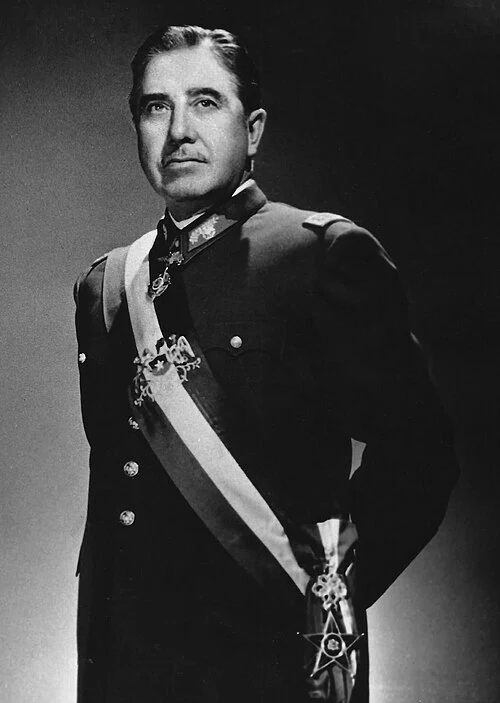
Augusto Pinochet (Spanish: Augusto Pinochet, November 25, 1915 - December 10, 2006) was a Chilean military commander and dictator who served as the president and head of the military government of Chile from 1973 to 1990. He came to power in a bloody military coup against democratically elected socialist President Salvador Allende, ending Chile's democratic system. During his reign, he implemented authoritarian rule, brutally suppressed left-wing opposition, and at the same time adopted neoliberal policies led by the "Chicago Boys" economically, creating the so-called "Chilean Miracle."
Pinochet was born in Valparaíso, Chile, in 1915. He died of heart failure on December 10, 2006. Although he has been dead for many years, the dual evaluation of him as a "savior" and a "tyrant" still deeply divides Chilean society.
_Want to know which historical leader your decision-making style is most similar to? Try the Political Leader Decision-Making Style Test to see if you have Pinochet’s iron-fisted and decisive qualities. _
Early Military Career and Career Advancement
Pinochet was born into a middle-class family, his father was a customs bureaucrat. He entered the military academy at the age of 18 and in the following decades demonstrated the rigor and loyalty of a professional soldier. He did not show an obvious political tendency during his military career, but focused on the study of military administration and tactics. He served as an instructor at the Chilean War College for many times and wrote books on geopolitics.
Against the backdrop of Chilean political polarization in the early 1970s, Pinochet's rise was dramatic. In August 1973, then-President Allende appointed Pinochet as Army Commander-in-Chief , believing that he was a professional officer who was loyal to the Constitution and did not interfere in politics. However, just 18 days later, Pinochet participated in and led the military operation to overthrow Allende's regime.
The 1973 Coup: The End of Democracy and the Establishment of a Military Government
On September 11, 1973, the Chilean army, navy, air force and police forces launched a joint coup. Due to soaring inflation, material shortages, and social unrest in Chile at the time, the military believed that violent means were necessary to "save the country from the threat of communism." President Allende committed suicide after the presidential palace, Moneda Palace, was bombed, and Pinochet subsequently became chairman of the military government council.
In the early days of taking power, Pinochet quickly dissolved Congress, banned all political party activities, and implemented strict censorship of the media. He established the principle of leadership , gradually weakened the power of other military chiefs through a series of decrees, and finally officially became president in 1974, beginning his 17-year dictatorship.
Iron-fisted repression and human rights disputes
The Pinochet regime was most criticized by the international community for its serious violations of human rights. In order to eliminate so-called "Marxists", the military government established a secret police agency called the National Intelligence Agency (DINA).
- Disappearances and massacres: According to later investigative reports (such as the Retich Report), approximately 3,000 people were executed or forcibly disappeared during Pinochet's rule.
- Torture and Imprisonment: More than 30,000 people were subjected to inhumane torture, and tens of thousands were imprisoned in makeshift concentration camps such as the National Stadium in Santiago.
- Exile: Nearly 10% of Chile's population (approximately 1 million people) choose to live in exile abroad for political or economic reasons.
Although this extreme stabilization measure eliminated the armed resistance in the short term, it also left an indelible mark of violence on Pinochet. When analyzing this extreme authoritarian ideology, it helps us understand the balance between "authoritarianism" and "liberty" in the political spectrum. You can take the 8values Political Values Orientation Test to measure your leanings on issues of state power and individual freedoms.
Economic Reform: The “Chilean Miracle” and the Neoliberal Experiment
In contrast to his extreme political conservatism, Pinochet carried out the most avant-garde economic experiments in the world at that time. He recruited a group of economists who had been mentored by Nobel Prize winner Milton Friedman at the University of Chicago, known as the "Chicago Boys."
core economic policy
- Privatization: Undoing the nationalization policies of the Allende era and returning hundreds of businesses, banks and even the social security system to private ownership.
- Reduce intervention: abolish price controls, significantly reduce import tariffs, and encourage foreign investment.
- Retrenchment: Combat hyperinflation through aggressive fiscal austerity.
Reform achievements and limitations
This policy achieved remarkable macroeconomic results. In the mid-to-late 1980s, the Chilean economy achieved rapid growth, inflation was under control, and it became one of the most stable economies in Latin America, known as the "Chilean Miracle." However, these reforms have also led to the sharp expansion of the gap between rich and poor, the damage to workers' rights, and the uneven distribution of basic medical and educational resources, which has become a social contradiction that has long plagued Chile.
Transition of power: the 1988 referendum and the return of democracy
Pinochet's dictatorship ended not with violent revolution, but with a poll that he believed was a sure win. Under the new constitution enacted in 1980, Chile held a referendum on Pinochet's re-election in 1988.
Although the government deployed a huge propaganda machine, the opposition successfully mobilized people who yearned for freedom through a peaceful campaign called "No". The referendum results showed that 56% of voters opposed Pinochet's re-election. Surprisingly, Pinochet eventually accepted the results of the vote and handed over presidential power to the democratically elected Patricio Irwin in 1990.
However, Pinochet made careful arrangements before leaving office: he remained army commander-in-chief until 1998 and was automatically made a senator for life by law, thus gaining legal immunity.
Trial in later life: London arrests and the struggle for justice
In 1998, while receiving medical treatment in London, England, Pinochet was arrested on an international arrest warrant issued by Spanish judge Baltasar Garzón. He is accused of killing and torturing Spanish citizens while in power.
This 503-day detention triggered a major controversy in the history of international law regarding universal jurisdiction . Although he was eventually allowed to return to Chile for health reasons, Pinochet's immunity from justice in Chile was subsequently stripped. In his later years, he faced hundreds of charges of murder, torture and hiding vast illicit fortunes in overseas accounts (the Regus banking scandal). He remained mired in legal troubles until his death in 2006 and was never formally convicted of his crimes, a move seen as a pity by many of his victims.
Later Influence and Historical Evaluation: The Political Legacy of Division
Pinochet is one of the most difficult figures in modern world history. In Chile, people's views on him are extremely polarized:
Advocate’s Perspective: The Nation’s Savior
Supporters believe that Pinochet prevented Chile from sliding toward Soviet-style totalitarianism through military intervention at a critical moment. The market economic framework he laid has prevented Chile from falling into long-term economic turmoil like neighboring countries (such as Argentina and Venezuela). In their eyes, Pinochet was a patriot who was willing to bear infamy for the sake of the country.
Opponent's Perspective: The Bloody Butcher
Opponents point out that no amount of economic growth can offset its human rights crimes. The model of rule he established was built on the suffering and lives of thousands of people. At the same time, the extreme privatization policies he implemented were considered to have deprived ordinary people of their basic welfare and sown the seeds of inequality in Chile's modern society.
international political significance
- Microcosm of the Cold War: Pinochet's coup was tacitly approved or supported by the CIA, reflecting the US's "anti-communist" strategy in Latin America during the Cold War.
- Economic paradigm: Chile’s reforms preceded Margaret Thatcher in the United Kingdom and Reagan in the United States, becoming a pioneer model for global neoliberal reforms.
- Rule of law precedent: The London skin arrest incident marks the international community's shaken view of dictators' "sovereign immunity".
Conclusion
Augusto Pinochet's life was a symphony of power and controversy. He was both a general who destroyed democracy through force and a president who reshaped the country's economy through reform. His rule reminded the world of the eternal tension between the pursuit of economic efficiency and the maintenance of human dignity and political freedom.
If you are interested in this kind of leadership trait that is strong-armed, economic transformation-oriented, and authoritarian, welcome to the Political Test Center . Through the Political Leaders Decision-making Style Test , you can analyze your subconscious choices when facing national turmoil, economic reform and power distribution from 48 professional questions to see if your character background is hidden in Pinochet-like decisiveness or controversy.
At the same time, if you want to understand where Pinochet's policies fit in the macro-political spectrum, you can check out 8values' detailed interpretation of all the resulting ideologies , compare various combinations of "conservatism", "authoritarianism" and "free market", and explore deeper political philosophy.