Thomas Sankara: Revolutionary Pioneer of Upper Volta (Burkina Faso) and Africa's Che Guevara
As the founding leader of Burkina Faso and one of the most influential revolutionaries on the African continent, Thomas Sankara’s radical social reforms, anti-colonial stance, and pursuit of national self-sufficiency are core cases for studying modern African history and socialist practice. By analyzing the success or failure of its "Sankaraism", you can participate in an in-depth 8values political value orientation test to compare the trade-offs of different revolutionary ideologies in terms of resource distribution, national sovereignty and social justice.
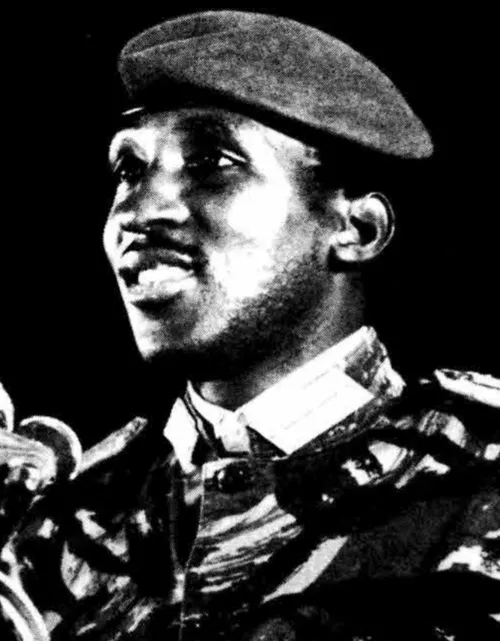
Thomas Sankara (French: Thomas Sankara, December 21, 1949 - October 15, 1987) was the first president of Burkina Faso , a Marxist revolutionary and a Pan-Africanist . He came to power in a popular coup in 1983 and changed the country's name from the colonial "Upper Volta" to "Burkina Faso" (meaning "land of upright people"). He actively promoted anti-imperialism , feminism and ecological protection , and tried to wean the country away from dependence on Western aid through drastic reforms. Due to his firm revolutionary will and simple lifestyle, he is widely hailed as "Africa's Che Guevara".
Sankara was born on December 21, 1949 in Yako, Upper Volta. On October 15, 1987, he was assassinated in a bloody military coup launched by his former comrade Blaise Compaoré at the age of 37.
_Want to know which historical leader your decision-making style is most similar to? Try the Political Leader Decision-Making Style Test to see if you have the qualities of a Sankara-like revolutionary. _
Early career and ideological tempering
Thomas Sankara was born into a Catholic family and belonged to the "Simi-Moses" group, a lower social class in West Africa. Although his parents wanted him to become a priest, he ultimately chose the military path. In 1966, 17-year-old Sankara entered Kedugu Military School, where he not only received rigorous military training, but also came into contact with Marxism and social sciences for the first time.
While training as an officer in Madagascar, Sankara witnessed the 1972 student movement against Tsiranana's government, which convinced him that "if the army is not politically aware, it is just a potential thug." He devoured the works of Marx, Lenin and Mao Zedong, and gradually formed his unique view of scientific socialism .
In 1974, Sankara became a national hero for his distinguished conduct during the border war with Mali. However, in addition to the honor of a professional soldier, he is more concerned about the suffering of the country's bottom class. He established an informal organization of left-wing military officers in Ouagadougou, including his future successor Compaoré. During this period, Sankara gained great popularity among the youth through his people-friendly image such as playing guitar (he was a member of the band "Gemini Seven") and riding a motorcycle. By the early 1980s, due to the political turmoil in Upper Volta, although Sankara held high government positions many times, he was always out of tune with the establishment because of his sharp anti-corruption rhetoric and radical stance.
The revolutionary seizure of power and the birth of Burkina Faso
On August 4, 1983, a military operation led by Compaore overthrew the then government of Jean-Baptiste Odedraogo, and Sankara was elected head of state. The revolution was not a traditional military coup and had widespread support among the urban poor, students and trade unions.
Upon coming to power, Sankara immediately set out to clear out the colonial legacy. In 1984, he changed the country's legal name from Haute-Volta to Burkina Faso. This name change has profound symbolic significance: it combines the two main local ethnic languages - Burkina (meaning "righteousness") and Diura (Faso, meaning "fatherland").
In order to establish a new model of national governance, he established the Committees for the Defense of the Revolution (CDRs) as an organization to mobilize the masses and implement grassroots management. Sankara believed that true freedom must be based on self-sufficiency . He famously said: "He who is in debt is a slave." To this end, he refused to accept loans from the International Monetary Fund (IMF) and World Bank, believing that these aids were a continuation of colonialism. This extreme defense of sovereignty has made him a "dangerous demagogue" in the eyes of Western political circles, especially the French government.
Radical social changes and miracles in people’s livelihood
During his four years in office, Sankara implemented a series of reform plans that were considered by later generations to be of advanced significance in Africa and even the world. These plans achieved great social progress at very low cost and became a model for socialist developing countries .
Revolution in healthcare and education
Sankara's government launched a mass vaccination campaign called Operation Hope. In just 15 days, Burkina Faso vaccinated 2.5 million children against measles, yellow fever and meningitis, a feat the World Health Organization (WHO) described as a miracle. In addition, he launched a nationwide literacy campaign that increased the literacy rate from 13% to 73%.
Land reform and food security
He abolished the land privileges of feudal chiefs and redistributed land to farmers. Burkina Faso's cereal production doubled in three years by building hundreds of dams and irrigation systems. Sankara proudly announced to the United Nations that Burkina Faso has achieved food self-sufficiency , and every citizen can guarantee two meals and clean water every day.
Environmental protection and the "Great Green Wall"
One of the first global leaders to recognize the threat of desertification, Sankara launched a tree-planting campaign. In the northern Sahel region, people have planted more than 10 million trees to prevent the Sahara Desert from encroaching southward. He required each village to establish its own forest and strictly prohibited logging, which was seen as the forerunner of ecological socialism in Africa.
When analyzing Sankara's ideology that emphasizes grassroots mobilization and distributive justice, it helps us understand how political values affect resource allocation. You can measure your inclination on such issues by taking the 8values political values orientation test , and view detailed interpretations of all 8values ideological results .
Pioneers of Women's Liberation and Social Justice
Sankara's views on gender equality are very forward-looking even from today's Western perspective. He once said: "Revolution and women's liberation are not two independent things, but the same thing."
He was the first West African leader to publicly ban circumcision (female genital mutilation), forced marriage and polygamy . Sankara promoted a large number of women to cabinet ministers, judges and military commanders. In order to let men experience the hard work of women, he even set up a "men go to the market day", requiring men to do housework. He encouraged women to leave the home and join militia training, promising that the government would protect them from domestic violence.
Although this all-round social restructuring has greatly liberated productivity, it has also seriously touched the core interests of local chiefs and traditional forces. When he implemented these policies, he often had a coercive tone based on leadership principles . This uncompromising attitude foreshadowed the subsequent tragedy.
A model of building a clean government and living a simple life
What the world admires most about Sankara is his simple life that is consistent with his words and deeds. Immediately after he came to power, he slashed the salaries of government officials and banned first-class flights and luxury cars for senior officials.
- Rejecting privileges: He changed the presidential car from a Mercedes-Benz to the cheapest light car in Germany, the Renault 5.
- Mandatory dress code: He required civil servants to wear the traditional clothing "Faso Dan Fani" handwoven from local cotton to revitalize the local textile industry.
- Personal Wealth: Sankara himself had almost no private property. According to the property list after his death, he only owned four old bicycles, a guitar, a refrigerator, a few old electric fans and an ordinary bungalow. His monthly salary was only US$450, making him one of the lowest-paid heads of state in the world at the time.
He even ordered the removal of air conditioning from the presidential palace on the grounds that "the vast majority of Burkinabe people cannot afford air conditioning." This zero tolerance for corruption and extreme insistence on self-discipline earned him god-like status among ordinary African people.
Fall and the "Autumn of Ouagadougou"
However, Sankara's revolution was not all plain sailing. Due to his refusal to compromise and the bureaucracy and excesses seen in the operation of the Committees for the Defense of the Revolution (CDRs), he gradually lost the support of parts of the middle class and intellectuals. At the same time, his tough anti-imperialist stance also caused thorns in the backs of neighboring countries such as Côte d'Ivoire and France.
On October 15, 1987, a military coup occurred in Burkina Faso. While Sankara was meeting with cabinet ministers, he was attacked by a commando commanded by his close comrade and number two Blaise Compaoré . Sankara was shot and killed as he walked out of the conference room. His body was then brutally dismembered and secretly buried in a desolate cemetery.
Compaore then seized power and announced a "revision" of Sankara's policies. He reestablished close ties with France, accepted loans from the IMF and ruled Burkina Faso for 27 years until he was toppled in popular protests in 2014.
The truth about Sankara's assassination has been the country's biggest political taboo for years. It was not until 2022 that the Burkina Faso military court officially sentenced Compaore (trial in absentia) to life imprisonment, finding him guilty of planning the murder.
Sankara’s political legacy and historical evaluation
Thomas Sankara's influence on human history, especially on the African national self-determination movement, is profound and dual-sided.
Historical Merits: Defender of African Dignity
Sankara is considered one of the few idealists on the African continent who can put theory into practice. He proved that a desperately poor, landlocked country could modernize and become food self-sufficient on its own. His actions against debt slavery and advocacy for environmental protection and women's rights were decades ahead of mainstream international society.
Controversies and Lessons
Critics say Sankara's rule smacks of authoritarianism . The Committee for the Defense of the Revolution that he established suffered from abuse of power and unfair trials in the later period, and even suppressed the independence of the trade unions. He was impatient when promoting social reforms, often changing traditions through executive orders rather than consensus, which led to social divisions.
Influence of later generations
- The flag of Pan-Africanism: Sankara's image is still emblazoned on the T-shirts of West African youth. His slogan "Eradicate hunger, eradicate poverty, and eradicate imperialism" remains the spiritual pillar of pan-African unity.
- Inspiration from the development model: His combination of "command economy" and "green revolution" provides a unique sample for modern ecological research.
- Indirect contribution to democratic awareness: The popular uprising that overthrew Compaoré in 2014 was widely hailed as the "revival of Sankara's spirit."
As many scholars have commented, without Thomas Sankara, Burkina Faso may always be just an obscure old French colony on the map. In a short period of four years, he injected a soul of "integrity" into this country. Although his life was ended, his vision that "Africans can manage Africa well" still echoes on the continent.
Extended reading : If you want to explore your own political decision-making tendencies, you are welcome to go to the Political Test Center and experience the political leaders’ decision-making style test . Through 48 professional questions, you will analyze your leadership characteristics from six dimensions such as decision-making style, power concept, and economic philosophy to see whether you are most like Stalin, Churchill, Roosevelt, or other historical leaders.