Napoléon Bonaparte: founder of the First French Empire, cornerstone of law and genius of war
As the emperor of the First French Empire and the reshaper of modern Europe, Napoléon Bonaparte's life spanned a legendary span from a small Corsican nobleman to a European overlord. He established the foundation of modern society through the Civil Code and rewrote the history of war with his genius military command. In addition to an in-depth analysis of the political ambitions and ruling style of this great historical figure, you can also conduct an in-depth 8values political values test to compare the evolution of ideologies in different historical stages.
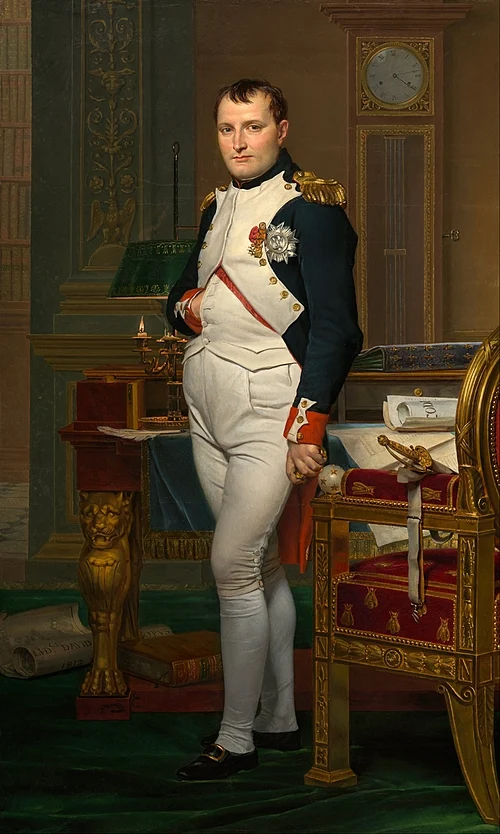
Napoleon Bonaparte (French: Napoléon Bonaparte, August 15, 1769 - May 5, 1821) was a famous military strategist and politician , the first consul of the First French Republic and the first emperor of the French Empire. Born in Corsica, he rose to prominence in the turmoil of the French Revolution with his military prowess. He not only swept across Europe through the Napoleonic Wars and established a huge imperial system, but also institutionalized the results of the Revolution through the promulgation of the Napoleonic Code , which had an indelible impact on the legal systems of various countries around the world.
Napoleon was born in Ajaccio on August 15, 1769. On May 5, 1821, he died of illness on the island of St. Helena, where he was exiled. His remains were returned to Paris in 1840 and buried at Les Invalides, where he was both admired and controversial by later generations.
_Want to know which historical leader your decision-making style is most similar to? Try the Political Leader Decision-Making Style Test to see if you have Napoleonic military decisiveness and grand vision. _
Rising from humble beginnings: The growth and training of the Corsican Eagle
When Napoleon was born, Corsica had just been transferred from the Republic of Genoa to France. As the second son of a declining minor nobleman, he had a strong dislike for the French rulers in his early days and even dreamed of achieving Corsican independence. At the age of 10, he entered the military school in Brienne, France, where he was ostracized by his classmates because of his small stature and thick accent. This sense of edge shaped his character's traits of self-reliance , forbearance , and eagerness to prove himself .
In 1784, Napoleon entered the Paris Military Academy with honors, majoring in artillery. At the age of just 16, he was awarded the rank of second lieutenant. During the subsequent French Revolution, he actively studied the works of Rousseau and other Enlightenment thinkers, and gradually transformed from a Corsican nationalist to a republican . The siege of Toulon in 1793 was his battle of fame. He defeated the royalist army and the British army with his keen artillery deployment. At the age of only 24, he was promoted to brigadier general.
By the time he was given command of the Italian Front in 1796, Napoleon had already demonstrated political acumen beyond his years. Not only did he frequently win on the battlefield, he was also good at using briefings and speeches to boost morale. This personal charm and publicity talent became his ladder to the top of power.
The Brumaire Coup and the Peak of Power
In 1799, the internal political situation in France was turbulent, the Directory was corrupt and incompetent, and there were anti-French alliances outside to suppress the situation. Napoleon secretly returned to Paris from the Egyptian front and launched the famous Coup d'État du 18 Brumaire with the support of the people and the army. He abolished the directorial government, implemented an executive government system, and became the first consul.
In 1804, in order to further consolidate his personal power and establish a stable inheritance system, Napoleon held a grand coronation ceremony at Notre Dame de Paris, officially proclaimed himself emperor, and established the First French Empire . During the coronation ceremony, he took the crown from Pope Pius VII and put it on the heads of himself and Queen Josephine. This move symbolized that he believed that the legitimacy of power came from his personal struggle and the authorization of the French people , rather than the traditional "divine right of kings."
He established a strict centralized system , reorganized local administration, and established provincial governors to be directly responsible to the central government. This centralized system greatly improved the operational efficiency of the country, but it also paved the way for his future dictatorship.
When analyzing Napoleon's political trajectory from republic to empire, it helps us understand the dynamic balance of power concentration. You can measure your balance point on issues such as authority and freedom, progress and tradition by participating in the 8values political value orientation test , and view the professional dimensions of all 8values result ideologies .
Sword of Law: "My true glory is my code of law"
Although Napoleon had a brilliant military record, he was most proud of his civil legislative achievements. The French Civil Code (later known as the Napoleonic Code) promulgated in 1804 is the first civil code in the modern sense in human history.
The core principles of the code include equality before the law , freedom of contract , sanctity of property rights and secularism . It completely destroyed the privileges of feudal lords and established the economic order of the bourgeoisie. As Napoleon's army swept through Europe, this code was also promoted to Italy, Belgium, and German states, and became the blueprint for the formulation of laws in many countries.
He once lamented: "My real glory is not winning forty battles. The Battle of Waterloo will erase all memories. But there is one thing that will not be forgotten. It will be immortal, and that is my Civil Code." This emphasis on the construction of the rule of law and social order made Napoleon regarded as "Robespierre in riding boots", that is, a person who used force to implement revolutionary principles.
Sweeping the Continent: The Art of Military Genius and Supremacy
Napoleon's military command is recognized as the top level in the world. He advocated the concentration of superior forces , rapid maneuvering and the annihilation of the enemy's effective forces .
The Battle of Austerlitz (also known as the "Battle of the Three Emperors") in 1805 was the pinnacle of Napoleon's military career. He used a weak force to lure the enemy deep, and then cut off the Russian-Austrian coalition forces through precise attacks and achieved a decisive victory, which directly led to the disintegration of the Holy Roman Empire. Thereafter, he brought almost all of Western and Central Europe under French control through the Treaty of Tilsit .
In order to completely defeat his old enemy Britain, Napoleon implemented the Continental Blockade Policy (Système Continental), which strictly prohibited continental European countries from trading with Britain. However, although this policy hit the British economy, it also led to skyrocketing prices in European countries, making people's lives difficult, and growing resistance.
In 1812, because Russia refused to fulfill the blockade agreement, Napoleon led an army of 600,000 to invade Russia . However, the "scorched earth policy" adopted by the Russian army and the harsh winter put the French army in a desperate situation. They suffered heavy losses during the retreat, and only tens of thousands of people returned to Poland. This defeat became a turning point in the empire's transition from prosperity to decline.
The hero's twilight years: Leipzig, the Hundred Days and Waterloo
In 1813, European countries formed the Sixth Anti-French Alliance and defeated Napoleon at the Battle of Leipzig (Battle of the Nations). In 1814, the Allies invaded Paris, and Napoleon was forced to abdicate and was exiled to the island of Elba in the Mediterranean.
However, the Corsican Eagle did not give in. In 1815, he miraculously sneaked back to France, and soldiers along the way switched allegiances upon his return. He returned to Paris and proclaimed himself emperor again, starting the famous "Hundred Days Dynasty" . However, in the subsequent Battle of Waterloo , facing the British army led by the Duke of Wellington and the Prussian army commanded by Blücher, Napoleon was ultimately defeated on the battlefield due to errors in coordination among his men and delays in objective fighter planes.
After that, he was exiled by the British to the remote Atlantic island of St. Helena. He spent the last six years of his life writing memoirs in an attempt to explain his policies and defend his place in history, until his death in loneliness in 1821.
Reforms and Contradictions: The Social Landscape of the Napoleonic Era
Economy and Infrastructure
Napoleon understood the importance of financial stability. He founded the Bank of France , unified the currency (the franc), and established an efficient tax collection and administration system. He strongly supported scientific research and industrial production and issued a series of laws aimed at protecting domestic industries.
In terms of urban construction, he ordered the construction of many triumphal arches, wide streets and bridges, which greatly improved the city appearance of Paris. He also promoted reforms in higher education and established a system of imperial universities and public secondary schools aimed at cultivating elite bureaucrats to serve the country.
Religion and social harmony
In order to ease the opposition between the government and the church since the Revolution, Napoleon and the Pope signed the "Ecclesiastical Treaty of 1801" . He acknowledged that Catholicism was "the religion of the majority of French people" but insisted that religion must serve the administration of the country. This compromise brought long-lost religious peace to French society and also established the government's right to supervise the church.
Suppression and speech control
As a dictator, Napoleon was extremely wary of dissent. He tightened press censorship and banned numerous newspapers critical of the government. His secret police network spanned the country and was run by the sinister and shrewd Fouche. He believed that necessary suppression was inevitable for the sake of national order and unity.
Historical Review: The Shadow and Legacy of Giants
Napoleon is one of the most controversial figures in history. He was both a heir to the Revolution and a trampler of freedom .
- Spreader of revolution: He broke the feudal shackles of old Europe through war and promoted the national awakening of various countries and the emergence of parliamentary systems.
- Autocratic usurper: Many republicans accused him of betraying the original intentions of the revolution and satisfying his personal vanity by establishing a dynasty.
- Military dogma: His tactical principles remained a required course in military academies in various countries until the end of the 19th century, profoundly influencing the form of modern warfare.
- Catalyst of nationalism: Although he tried to unify Europe, his conquests in Germany, Italy, and Spain instead aroused the sense of national identity in these regions, which indirectly led to the subsequent unification movement of Germany and Italy.
As he said on St. Helena: "My reputation will be made of facts." Napoleon was a man who pushed his personal will to the extreme. He proved that one person can change the direction of the entire world with his intelligence and perseverance. His name has become synonymous with ambition and immortal legislation .
Extended reading : If you want to explore your own political decision-making tendencies, you are welcome to go to the Political Test Center and experience the political leaders’ decision-making style test . Through 48 professional questions, you will analyze your leadership characteristics from six dimensions such as decision-making style, power concept, and economic philosophy to see whether you are most like Napoleon, De Gaulle, Lincoln, or other historical leaders.