Abraham Lincoln: Savior of the United States of America and Architect of the People, by the People, for the People
Abraham Lincoln, the 16th President of the United States, is one of the most respected leaders in American history. During the American Civil War, when the country was dying, he resolutely safeguarded the unity of the Union and signed the Emancipation Proclamation. By deeply understanding the decision-making logic and republican ideals of this great president, you can also take a professional 8values political value orientation test to explore the collision of different ideologies in the great changes in history.
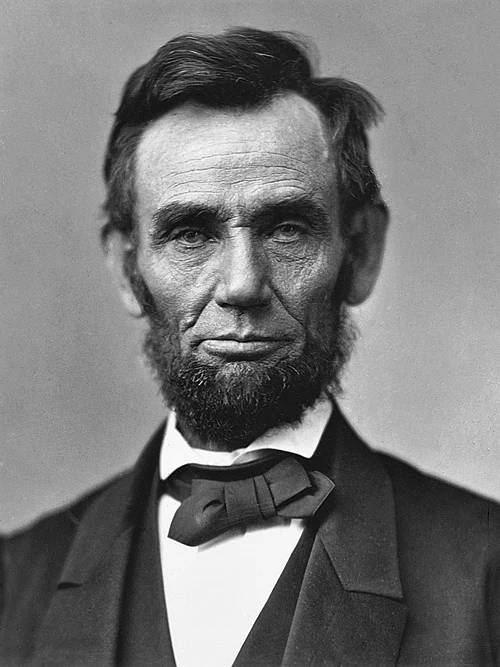
Abraham Lincoln (English: Abraham Lincoln, February 12, 1809 - April 15, 1865) was the 16th President of the United States and the first Republican President. He led the United States through the most tragic internal conflict in its history, the American Civil War (Civil War), successfully abolished slavery , maintained the integrity of the Union, and promoted the modernization of the American economy. Lincoln is world-famous for his political wisdom, oratory skills, and firm belief in democratic principles. The government concept of "of the people, by the people, for the people" he proposed in the Gettysburg Address remains the cornerstone of modern democratic politics.
Lincoln was born into a poor family in Hodgenville, Kentucky on February 12, 1809. On April 14, 1865, just as the Civil War was coming to an end, he was assassinated at Ford's Theater in Washington and died early the next morning. Lincoln's life symbolizes the ultimate American dream - from a cabin in the wilderness to the White House, from a self-struggled lawyer to a saint who saves the country from danger.
_Want to know which historical leader your decision-making style is most similar to? Try the Political Leader Decision-Making Style Test to see if you have Lincoln-like qualities of resilience and empathy. _
Growth in the wilderness and early career of self-redemption
Lincoln's early life is a typical history of frontier struggle. His parents were barely literate farmers, and Lincoln himself received no more than 12 months of formal education in total during his life. However, he had an almost fanatical thirst for books, and while working on the frontier, he taught himself the Bible, Shakespeare's works, and legal books. This spirit of self-study not only endowed him with excellent rhetorical skills, but also shaped his profound humanitarian values.
In 1831, Lincoln moved to New Salem, Illinois. Here he worked in various occupations: splitting wood, working as a store clerk, working as a surveyor, and even as a rural postman. He was known among the locals as "Honest Abel." This period of life gave him a deep understanding of the hardships of the working class, and also gave him a firm belief in the value of free labor , which became the starting point of his later opposition to the expansion of slavery.
In 1834, at the age of 25, Lincoln entered politics and was elected to the Illinois House of Representatives. During this period, he began to study law on his own and was qualified to practice law in 1836. He then moved to Springfield and began a 25-year legal career. Lincoln was not only known for his strict logic and sharp rhetoric in court, but also gained insight into the contradictions among all social strata in handling various cases, which accumulated valuable experience for him to deal with complex national political issues in the future.
From Whigs to Republicans: The Evolution of Political Ideology
Lincoln was originally a staunch supporter of the Whig Party . He admired Henry Clay and supported the "American System," which advocated the protection of industry through tariffs, the establishment of a national bank, and internal improvements such as the construction of canals and railroads to promote economic development. He believed that the government should actively intervene to provide ordinary people with opportunities to move up the social ladder.
However, the passage of the Kansas-Nebraska Act of 1854 changed the American political landscape. This act allowed newly admitted states to decide whether to implement slavery through "popular sovereignty", which effectively abolished the Missouri Compromise that restricted the expansion of slavery. Outraged, Lincoln returned to politics and joined the emerging Republican Party in 1856.
During his famous debate on slavery with Stephen Douglas in 1858, Lincoln delivered his famous “Separation Speech”:
"A divided house cannot stand for long. I believe this government cannot remain half slave, half free forever."
Lincoln's political stance at this time was moderate opposition to expansion . Although he did not advocate the immediate abolition of slavery across the United States (for constitutional and realpolitik considerations), he firmly opposed the expansion of slavery into the new western territories. He believed that as long as its expansion was restricted, slavery would eventually die out naturally. This stance that combines idealism with political reality has made him a leading figure in the Republican Party.
Called for duty: The 1860 election and the outbreak of the Civil War
In 1860, Lincoln won the Republican presidential nomination on the strength of his reputation in the debates and his moderate political image. In the subsequent national election, due to the split in the Democratic Party, Lincoln was successfully elected as the 16th President of the United States.
Lincoln's victory was viewed by southern slaveholders as a direct threat to their way of life. Before he officially took office, seven southern provinces, led by South Carolina, announced their secession from the Union and established the "Confederate States of America." On April 12, 1861, the Southern Army opened fire on Fort Sumter, and the American Civil War officially broke out.
Facing the biggest crisis since the founding of the country, Lincoln showed amazing decisiveness. He quickly called for volunteers, instituted a naval blockade, and invoked emergency wartime powers. When analyzing Lincoln's ideology of seeking balance and breakthroughs in crises, it helps us understand how political values play a role in extreme environments. You can measure your inclination on such issues by taking the 8values political values orientation test , and view detailed interpretations of all 8values ideological results .
Baptism in Fire: Leadership as Commander-in-Chief of the Armed Forces
In the early days of the Civil War, the Union Army suffered repeated defeats on the battlefield. Lincoln faced tremendous political pressure, both from the attacks of the "Copperheads" who advocated an armistice and from the "Radical Republicans" who advocated the immediate abolition of slavery.
Lincoln demonstrated a continual learning ability in military leadership. He studied military books in depth, often visited the front lines in person, and continued trial and error in the process of finding qualified generals. After experiencing a series of indecisive commanders, he finally discovered and trusted Ulysses S. Grant , a general who could understand Lincoln's strategic intention of "totally destroying the rebel resistance", and finally turned the tide of the war.
In politics, Lincoln displayed the highest art. He knew that the first goal of the Civil War was to preserve the Union . In an effort to gain support from the border states, he was initially cautious about the slavery issue. But as the war progressed, he realized that slavery was not only a moral stain, but also the source of the South's war potential.
In September 1862, after the victory at the Battle of Antietam, Lincoln issued the preparatory "Emancipation Proclamation." On January 1, 1863, the declaration came into effect. This move fundamentally changed the nature of the war, sublimating it from a war to maintain unity to a holy war for human freedom . This morally prevented European powers such as Britain and France from intervening and supporting the South. It also allowed black soldiers to join the federal army, greatly enhancing the military power of the North.
Gettysburg and the Second Inauguration: A Highest Tribute to the Democratic Spirit
In July 1863, the Union Army won a key victory at the Battle of Gettysburg . In November of the same year, Lincoln delivered his famous "Gettysburg Address" at the Memorial Cemetery. This speech of only 272 words redefined the founding spirit of the United States.
Lincoln emphasized that the United States was not founded on blood or geography, but on the proposition that "all men are created equal." He vowed to enable the United States to experience "a new birth of freedom" and ensure that "this government of the people, by the people, for the people, shall never perish from the face of the earth."
In early 1865, with Northern victory in sight, Lincoln demonstrated a magnanimity that transcended hatred in his second inaugural address. He did not talk about revenge, but instead proposed the principle of reconstruction of " treating others not with malice, but with compassion ." He hoped that after the war was over, the country's wounds could be healed quickly and the southern states would return to the embrace of the Union.
Final victory and assassination plot
On April 9, 1865, General Robert E. Lee, the commander of the South, surrendered to Grant, effectively ending the Civil War. Lincoln began to actively plan for postwar reconstruction . He advocated a tolerant policy that would restore citizenship as long as Southerners swore allegiance to the Union and recognized the abolition of slavery.
However, the dawn of peace was fleeting. On the evening of April 14, 1865, Lincoln was shot in the head at close range by actor John Wilkes Booth , a radical Southern supporter, while watching the play "Our American Kin" at Ford's Theater in Washington. Early the next morning, this great president passed away suddenly.
Lincoln's assassination shocked the world. He became the first president to be assassinated in the history of the United States, and also became a martyr for maintaining the unity of the Union and pursuing equality. Millions of people mourned on an unprecedented scale as his casket traveled from Washington to Springfield, Illinois.
The Great Legacy: The End of Slavery and the Birth of Modern America
Lincoln's achievements in office went far beyond victory in the war. He promoted a series of policies that profoundly affected the future of the United States:
Abolition of Slavery and Constitutional Amendment
Lincoln knew that the Emancipation Proclamation was only a wartime act. In order to permanently abolish slavery, he lobbied Congress hard in early 1865 to pass the Thirteenth Amendment to the Constitution . This act legally ended the two-hundred-year-long slavery system in the United States and completed the most significant social change in American history.
Promote economic modernization
In the midst of the war, the Lincoln administration still passed a number of forward-looking bills:
- "Homestead Law": It stipulates that citizens can obtain land in the west by paying only a small fee, which greatly promotes the development of the west and the development of small farmer economy.
- Pacific Railroad Act: Authorized the construction of the transcontinental railroad, which later directly promoted the industrialization process of the United States.
- The Morrill Land Grant Act: funded states to establish agricultural and mechanical colleges, which became the prototype of the modern higher education system in the United States.
- National banking system: Established a unified national banking framework and standard currency system, laying the financial foundation for the post-war economic prosperity.
Leadership Style and "Cabinets of Political Enemies"
Lincoln's art of employing people is often praised by later generations. He dared to recruit political opponents into his cabinet (such as Secretary of State Seward and Secretary of the Treasury Chase) and use their talents to serve the country. He used great patience to balance the contradictions among the various factions in the cabinet. This inclusive and empathetic leadership enabled him to gather the broadest possible strength to deal with the crisis.
Historical evaluation and controversy
Although Lincoln is regarded as a saintly hero today, in his own time he was surrounded by controversy.
- Dictatorship charges: During the war, Lincoln suspended habeas corpus and restricted some freedoms of the press. This aroused heated discussion among constitutional scholars at the time, who believed that he had exceeded his authority and exercised administrative functions.
- Evolution of views on race: Modern historians often discuss Lincoln's early views on racial equality. He early on considered plans to emigrate freed blacks to Africa or the Caribbean. However, Lincoln's greatness lay in the dynamic evolution of his ideas. By the end of the war, he had begun openly advocating for voting rights for educated blacks and black soldiers, a progressive idea that was extremely courageous at the time.
As Marx once said of Lincoln:
"He is an ordinary person who works tirelessly towards great goals without boasting. He is an ordinary person who achieves an epic career."
Lincoln not only saved the United States of America, he reshaped its soul. He proved to the world that a democratic government could survive an internal crisis and be reborn through the rule of law and its ideals without sacrificing freedom.
Extended reading : If you want to explore your own political decision-making tendencies, you are welcome to go to the Political Test Center and experience the political leader decision-making style test . Through 48 professional questions, you will analyze your leadership traits from six dimensions including decision-making style, view of power, and economic philosophy to find out whether you are most like Lincoln, Churchill, Roosevelt, or other historical leaders.