Margaret Thatcher: The rise, transformation and legacy of the Iron Lady
As the first female Prime Minister in British history, Margaret Thatcher's economic reforms (Thatcherism), her tough stance on trade unions, and her decisive decision in the Malvinas War completely reshaped Britain in the second half of the 20th century. By gaining an in-depth understanding of the Conservative leader's political leanings, you can also take a comprehensive 8values political values test to compare the trade-offs between different ideologies when it comes to free markets and social order.
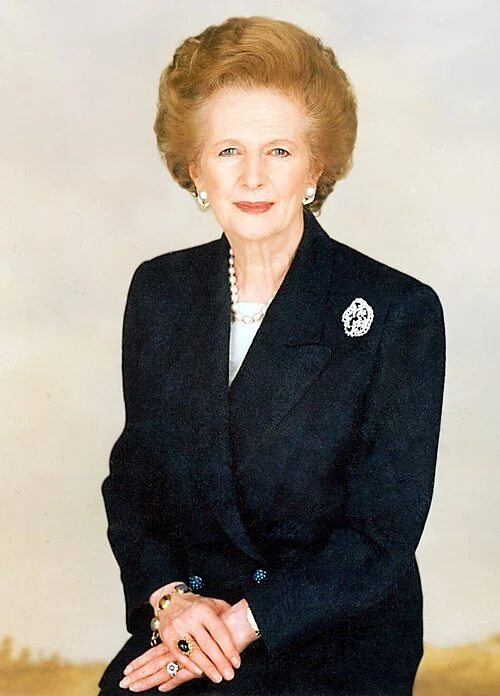
Margaret Thatcher (English: Margaret Hilda Thatcher, October 13, 1925 - April 8, 2013) was a famous British Conservative politician who served as the British Prime Minister from 1979 to 1990. She is not only the first female Prime Minister in British history, but also the longest-serving British Prime Minister in the 20th century. Because of her tenacious political style and tough attitude towards the Soviet Union, she was dubbed "The Iron Lady " by the Soviet media. This nickname later became her global political label.
When Margaret Thatcher came to power, Britain was mired in the " British Disease ", facing high inflation, frequent strikes and economic stagnation. By promoting privatization, cutting social welfare, limiting the power of trade unions and advocating free market competition, she formed a political and economic system known as " Thatcherism ". On the international stage, she kept a high degree of synchronization with US President Ronald Reagan and jointly promoted the liberal wave at the end of the Cold War.
Margaret was born in 1925 in Grantham, Lincolnshire, to a grocer's family. In 1945, she earned her way to Oxford University to study chemistry. Eventually, she died of a stroke in 2013 at the age of 87. Her life not only rewrote the social structure of Britain, but also triggered lasting debates about neoliberalism and social justice.
_Want to know which historical leader your decision-making style is most similar to? Try the Political Leaders Decision-Making Style Test to see if you have Thatcher-like determination and execution. _
Civilian origin and the foundation of political beliefs
Margaret Hilda Roberts was born into a typical middle-class family. Her father, Alfred Roberts, not only ran a grocery store, but was also a local Methodist and Conservative alderman. This value, deeply rooted in the Methodist ethos - an emphasis on thrift, personal endeavor and self-responsibility - became a core cornerstone of Mrs Thatcher's later political philosophy.
She excelled academically and was admitted to Somerville College, Oxford University, in 1943. While at Oxford, she was elected president of the Oxford University Conservative Association in 1946, becoming the third female president in the organization's history. After graduating from college, she initially worked as a chemical researcher and was involved in researching emulsification technology for ice cream. However, her passion for politics never died out. In 1951 she married businessman Denis Thatcher, and with her husband's financial support she began studying law and becoming a tax lawyer.
She ran as the youngest female candidate in the 1950 and 1951 elections, and although she failed to win, her sharp debating style emerged. In 1959, she was finally elected as the MP for Finchley and officially entered the heart of politics. She has always firmly believed that the state should not interfere too much in personal lives, and that individualism and free will are the engines that drive social progress.
Taking charge of the Conservative Party and the 'winter of discontent'
After the Conservative victory in 1970, Mrs Thatcher served as Secretary of State for Education and Science in Edward Heath's cabinet. She was once criticized by the media as "Thatcher the Milk Snatcher" for canceling the free milk supply in schools. This experience sharpened her psychological quality to resist the pressure of public opinion and also made her aware of the weakness of the middle line.
After the Conservatives lost the 1974 general election, doubts arose within the party about Heath's leadership. In 1975, Margaret Thatcher decisively launched a challenge, shockingly defeating Heath and becoming the first female leader of the Conservative Party . Over the next four years, she worked to reshape the Conservative Party's ideology from a mildly paternalistic conservatism to a new right that emphasized liberal economics and social discipline .
From the end of 1978 to the beginning of 1979, a serious cross-industry strike broke out in the UK, known in history as the " Winter of Discontent". The garbage piled up so much that even the dead could not be buried. The chaos has fueled public despair against the unions and Labor government. In May 1979, Mrs. Thatcher followed public opinion and won the general election, beginning an 11-year term as prime minister.
Thatcherism: A 'surgical operation' on a British disease
After Mrs. Thatcher took office, she immediately began to solve the structural problems that had been plaguing Britain for a long time. She believes that Britain's decline stems from excessive government intervention and the expansion of the power of trade unions.
Monetarism and Curbing Inflation
Unlike Keynesianism, which used fiscal expansion to reduce unemployment, Mrs. Thatcher believed in monetarism . She slashed government spending and raised interest rates to control the money supply. Although this strategy caused the unemployment rate to soar to more than 3 million in the short term, triggering serious social unrest and intra-party opposition, she still made a famous statement at the 1981 Party Congress: " If you want to turn around, you can, but I will never turn around. " (The lady's not for turning).
privatization wave
In order to break the state monopoly and improve economic efficiency, Mrs. Thatcher launched a large-scale privatization process. Many state-owned enterprises, including British Telecom, British Airways, and British Gas, were sold to private investors. This not only brought back huge financial funds, but also allowed millions of ordinary British people to hold stocks for the first time, which she called " mass capitalism ."
taming unions
The miners' strike of 1984 to 1985 was a watershed in Thatcher's career as prime minister. Faced with the challenge of Arthur Scargill, chairman of the National Union of Mineworkers, Mrs. Thatcher stockpiled coal resources in advance and used powerful police to maintain social order. After a year of tug-of-war, the miners' union returned to work unconditionally. After the war, the political influence of British trade unions was significantly weakened and the labor market became more flexible.
Analyzing this ideology, which emphasizes competition and undermines collective welfare, helps us understand the workings of right-wing liberalism across the political spectrum. You can measure your inclination on issues of economic freedom and equality by taking the 8values political value orientation test , and view detailed interpretations of all 8values ideological results .
The game of iron fist and diplomacy on the international stage
In terms of diplomacy, Mrs. Thatcher pursued firm realism and patriotism , and was committed to restoring Britain's dignity as a world power.
Victory in the Falklands War
In 1982, Argentine forces occupied the Malvinas Islands, a British overseas territory. Faced with doubts at home and abroad, Mrs. Thatcher defied all odds and formed a task force to expedition to the South Atlantic. The British army finally recaptured the islands with extremely high combat efficiency. This victory not only cleared up the frustrations that Britain had felt since World War II, but also laid the foundation for Mrs. Thatcher's landslide victory in the 1983 general election.
Relations with the Soviet Union and Eastern Europe
Although Mrs Thatcher was a staunch anti-communist, she also showed a pragmatic side. She was the first among Western leaders to discover the potential of Mikhail Gorbachev, describing him as " a person with whom you can do business ." This keen insight served as an important bridge to the end of the Cold War.
The European Community and the "Right of Refund"
On European affairs, Mrs. Thatcher has always been skeptical of European integration (Euroscepticism). She once shouted in a famous speech: " Give me my money back! " (I want my money back!), and ultimately successfully fought for the return of the European Community's budget to the UK. She opposed the establishment of a single European currency, believing that it would deprive member states of their sovereignty, a view that had a profound impact on subsequent British political trends.
The End of Power: Poll Taxes and Separation
In 1987, Margaret Thatcher reached the pinnacle of her power when she won a third term. However, as his term was extended, his autocratic style caused dissatisfaction among cabinet members.
In 1990, she imposed a community charge (commonly known as the "Poll Tax "), requiring every citizen to pay the same fixed amount of tax, regardless of wealth or poverty. This highly controversial policy triggered large-scale protests and riots across the UK. Meanwhile, her intransigence on European integration led to the resignation of deputy prime minister Geoffrey Howe and sparked a challenge to her leadership in parliament.
On November 22, 1990, Mrs Thatcher announced her resignation after failing to win the first round of the party leadership election. She left No. 10 Downing Street with tears, but still insisted in her last words: " We are leaving Downing Street, and we are happy that we have left Britain better than when we came. "
Margaret Thatcher's Controversy, Legacy and Place in History
Divide of economic evaluation
Supporters credit Thatcher with saving Britain from becoming a third-rate European nation. She revitalized the City of London by introducing competition (the Big Bang Reforms), making Britain a global financial center again.
Opponents accuse her of destroying Britain's manufacturing industry, widening the gap between rich and poor and undermining the social contract. Her famous statement, " There is no such thing as society, only individuals and families ," is seen as proof of a lack of social responsibility. She is still hated by many in the old industrial areas of northern England, Scotland and Wales.
social and cultural reform
On social policy, Mrs. Thatcher held a conservative stance. She implemented the famous " Section 28 " ban on local government and schools promoting homosexuality. However, she also left a complex footprint in science, environmental protection (such as an early focus on the greenhouse effect), and educational reform.
historical influence
Margaret Thatcher is one of the very few people whose name defines an era. Her policies even influenced the transformation of the Labor Party (New Labour) in the 1990s, with Tony Blair admitting that he had to accept many of the economic frameworks set by Thatcherism.
- Political Pioneer: As the first female prime minister of a major Western power, she broke the "glass ceiling" in politics.
- Ideological symbols: Thatcherism and Reaganism together formed the global picture of neoliberal economics at the end of the 20th century.
- Institutional changer: She completely ended the moderate "two-party consensus" in post-war Britain and pushed politics into a more confrontational competitive model.
As historians have noted, Thatcher was not a politician seeking compromise but one seeking change. She once said: " If you just want to be popular, you will achieve nothing. " This stubbornness to principles is not only the driving force for her success, but also the reason why she eventually betrayed everyone.
Extended reading : If you want to explore your own political decision-making tendencies, you are welcome to go to the Political Test Center to experience the political leaders’ decision-making style test . Through 48 professional questions, you will analyze your leadership characteristics from six dimensions such as decision-making style, power concept, and economic philosophy to see whether you are most like Margaret Thatcher, Merkel, or other historical leaders.